ResearchElectric fields in drops
Moving particles inside drops with electric fields
A uniform electric field turns non-uniform around a drop, and the resulting dielectrophoretic force can herd the particles on a drop's surface to its poles. Turn the field up further and the drop tip-streams, throwing the particles out and leaving it clean. We worked out when this is possible and showed it in water drops and giant vesicles.
- Talk
- APS Division of Fluid Dynamics 2023, Washington, DC
- Authors
- S. S. Verma, K. Jawney, I. S. Fischer, P. Singh
- Methods
- AC electric fields, dielectrophoresis theory, optical microscopy
- Range
- Drops 180 to 805 µm; fields up to 5 kV, 1 kHz to 1 GHz
The goal
Particles trapped on the surface of a drop are hard to move. The aim here is to gather them with an electric field, then remove them, and to find the conditions under which that works.
A drop in a uniform field
When a drop and the liquid around it have different dielectric properties, an applied field polarizes the drop. There is no net force, so the drop does not move, but it stretches along the field. Above a critical field strength it breaks up or tip-streams, shedding fluid from its ends. A smaller drop resists stretching because surface tension dominates.
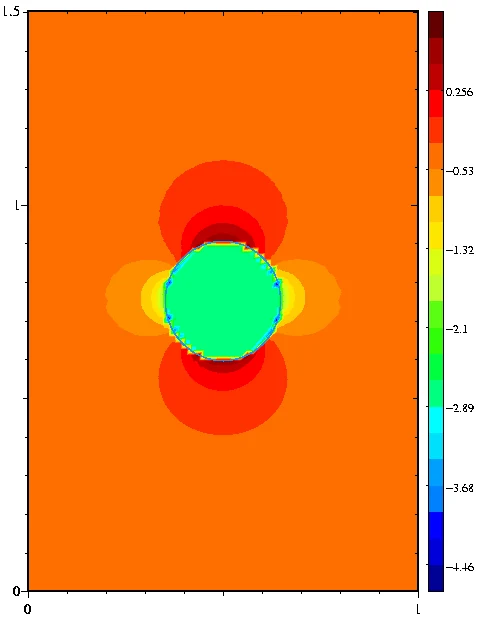
The drop also distorts the field around it. Even when the applied field is uniform, it is strongest at the drop's poles and weakest at its equator. That has two consequences: the electric stress on the drop's surface is uneven, which deforms it, and a particle on or near the surface sits in a non-uniform field.
Dielectrophoresis
A particle in a non-uniform field feels a dielectrophoretic (DEP) force along the gradient of the field squared. In the point-dipole approximation, for a particle of radius R:
FDEP = 2πε0εcR³ β′ ∇E²
ε0 is the permittivity of free space and εc that of the surrounding liquid. The Clausius–Mossotti factors of the particle and of the drop,
β′ = Re εp* − εc*εp* + 2εc*, β = Re εd* − εc*εd* + 2εc*
depend on the frequency-dependent complex permittivities of the particle, drop and liquid. When β′ > 0 a free particle moves toward the field maximum (positive DEP); when β′ < 0 it moves toward the minimum (negative DEP).
For a particle on the surface of a drop of radius a in an applied field E0, the tangential force works out to
FDEP,θ = −12π R³a ε0εcE0² β′β(2 + β) cos θ sin θ
- Direction
The sign of ββ′ decides where particles go. If ββ′ > 0 they gather at the poles; if ββ′ < 0, at the equator.
- Drop size
The force grows as the drop radius a shrinks, so particles on smaller drops are easier to move.
Break up or sort first?
Two things happen as the field rises. At some strength the drop breaks up or tip-streams. At another, the DEP force overcomes the particles' buoyant weight and they start to move. Sorting is only possible if the second comes first. Comparing the electric Weber number with a gravity parameter gives a critical drop radius:
acrit = 3 (γβ′(2/β + 1) Wecrit2(ρp − ρf)g)1/2
Particles can be moved only on drops smaller than acrit. The condition does not depend on the field strength or on the particle size, only on the drop radius and the physical properties. For a density difference of 500 kg/m³ and a surface tension of 0.02 N/m, the drop must be smaller than about 1 mm.
Experimental setup
We built a small transparent cell with electrodes on its side walls and a Teflon-coated hydrophobic base, so drops sit on it without spreading. Drops loaded with particles are placed in the cell with a microsyringe, a high-voltage amplifier drives the electrodes, and cameras on microscopes image the drop from above and below.
Particles at the poles
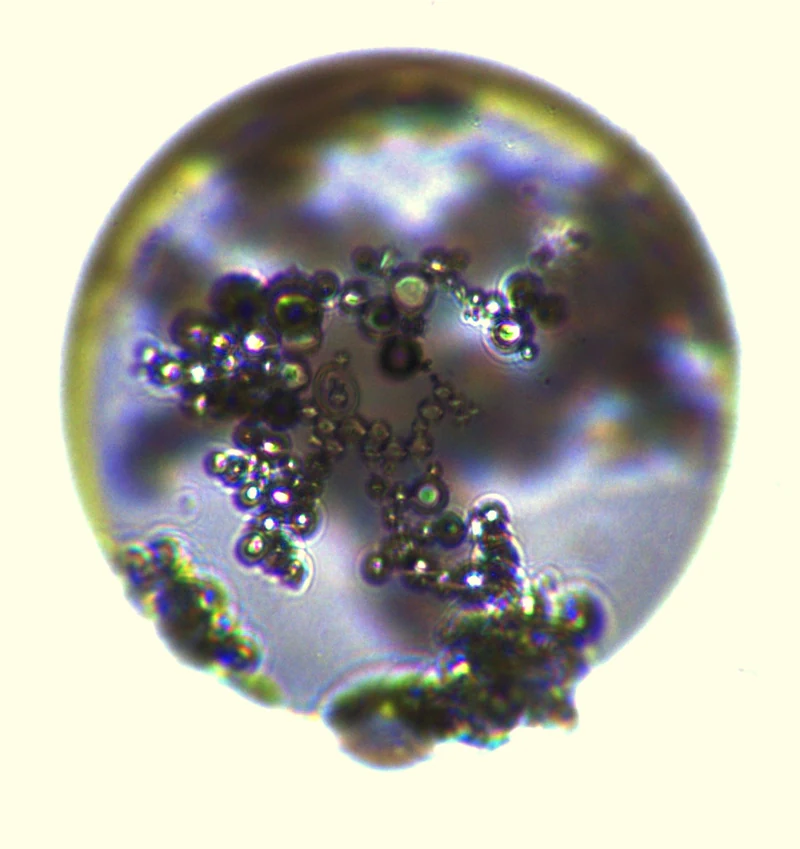
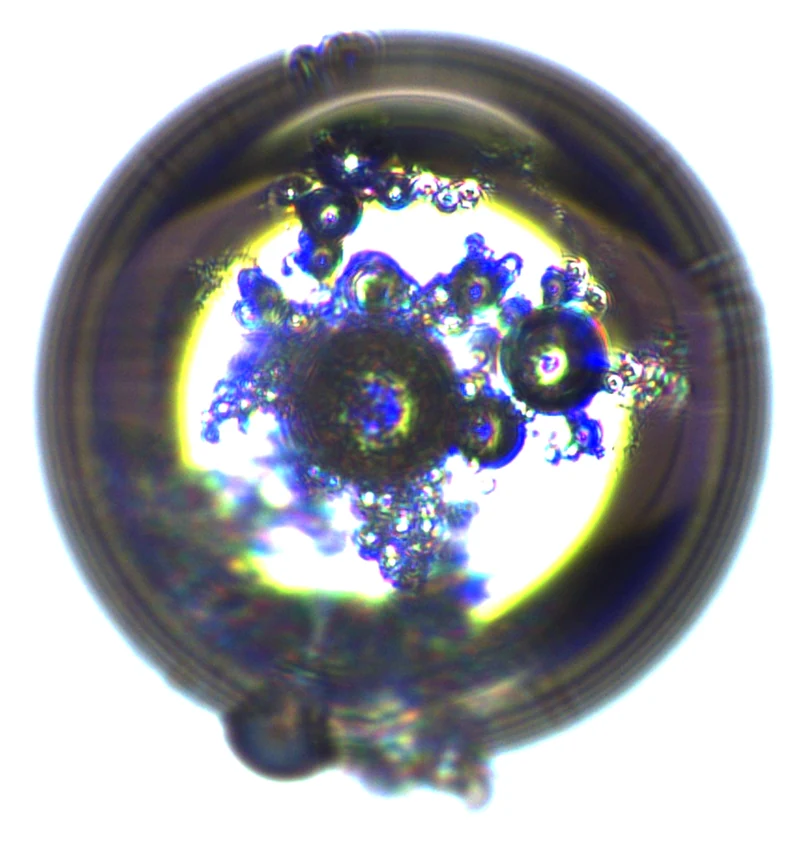
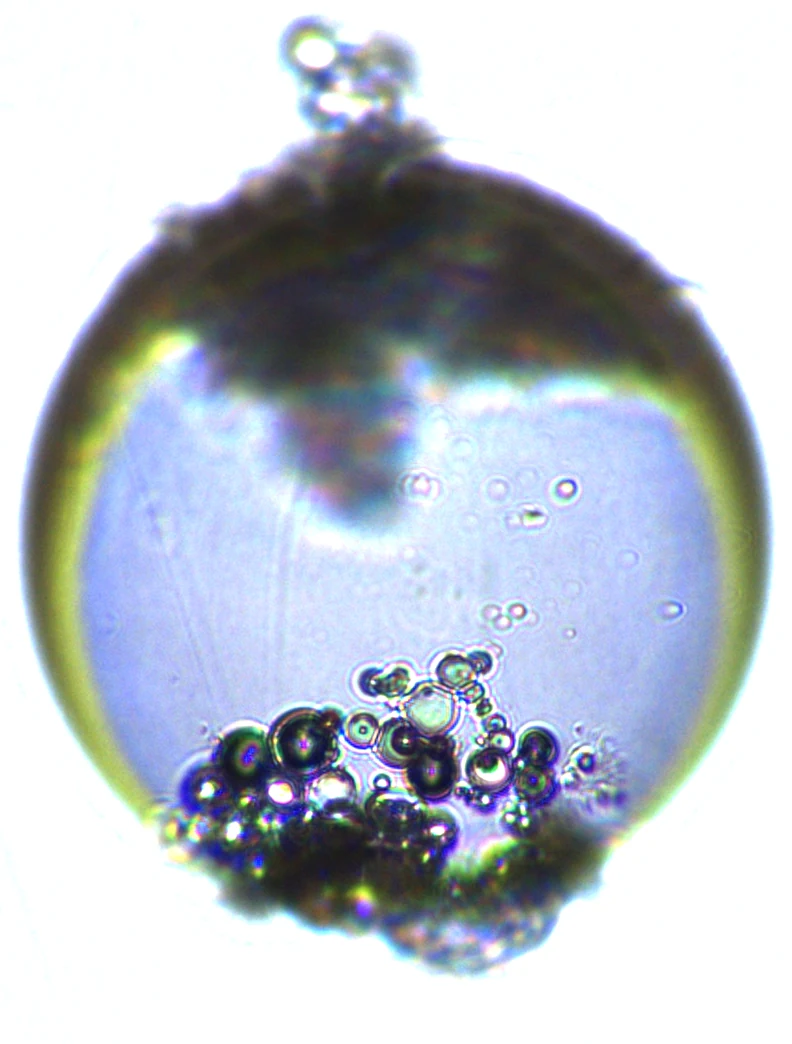
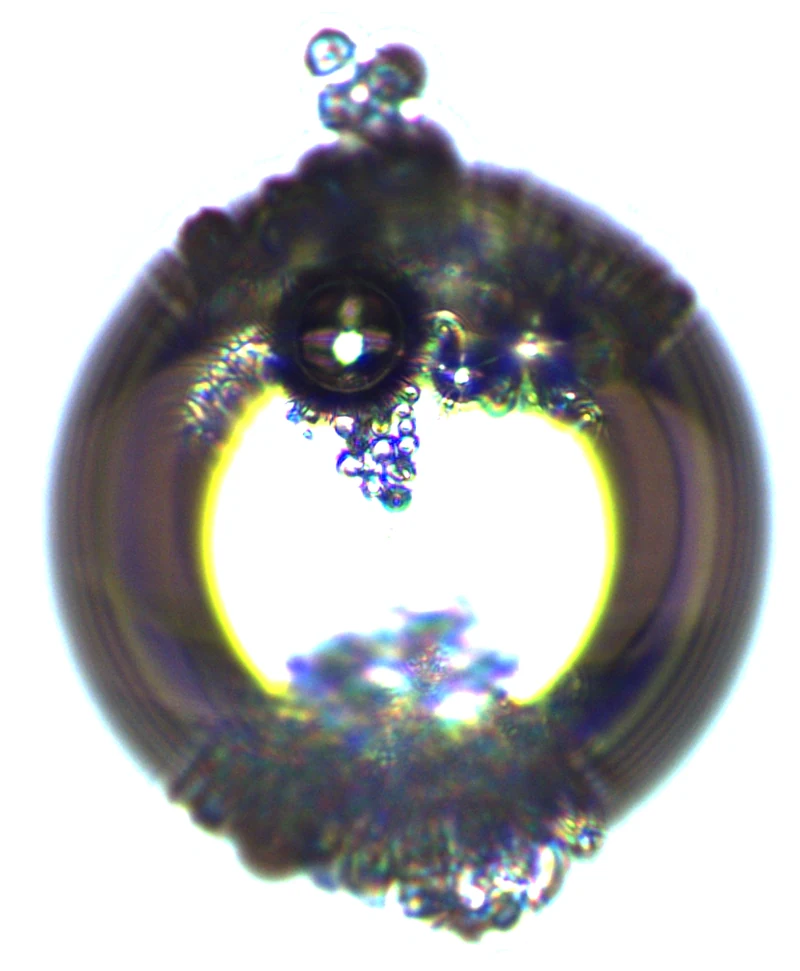
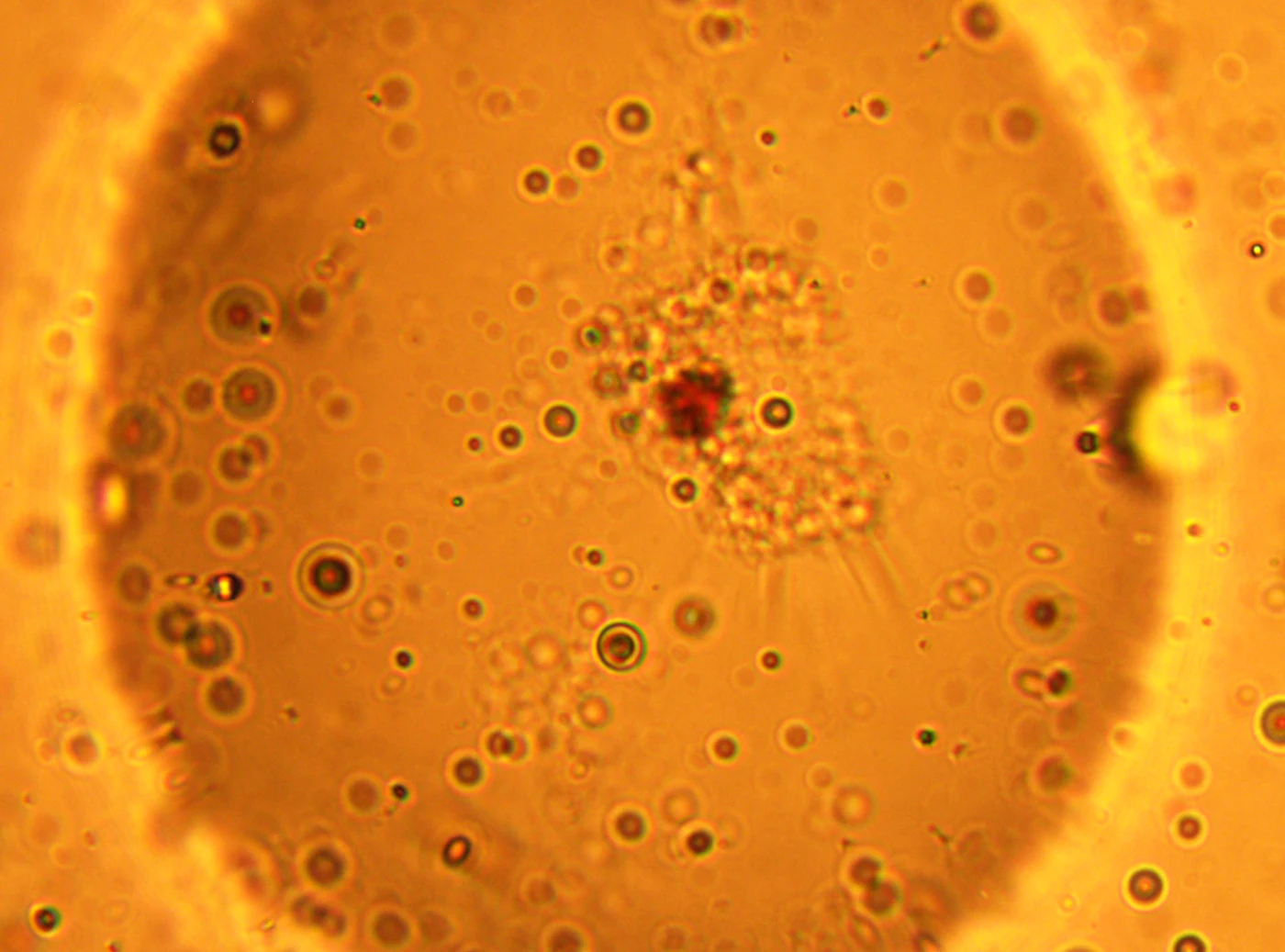
A 180 µm water drop sat in corn oil, carrying hollow glass particles 16 to 20 µm across. Glass has a dielectric constant of about 2.5, lower than both water and corn oil, so both Clausius–Mossotti factors are negative and their product is positive. At around 3000 V, the particles moved to the poles. The drop kept its shape, because at this size surface tension wins over the electric stress.
Bottom of drop
Top of drop
Before
After
Cleaning a drop
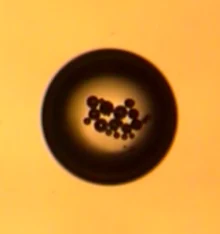
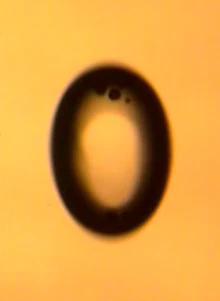
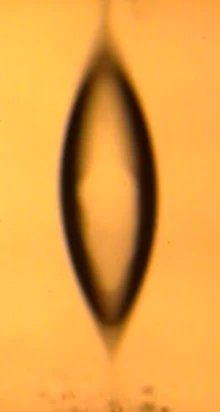
To remove the particles, we first gathered them at the poles and then raised the field abruptly. In an 805 µm water drop in corn oil carrying extendospheres about 50 µm across, 3000 V collected the particles at the poles. A jump to 4000 V stretched the drop into Taylor cones that tip-streamed and ejected the collected particles. With the field switched off, the drop was clean.
0 V
3000 V
4000 V
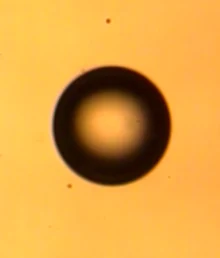
Field off
Giant vesicles
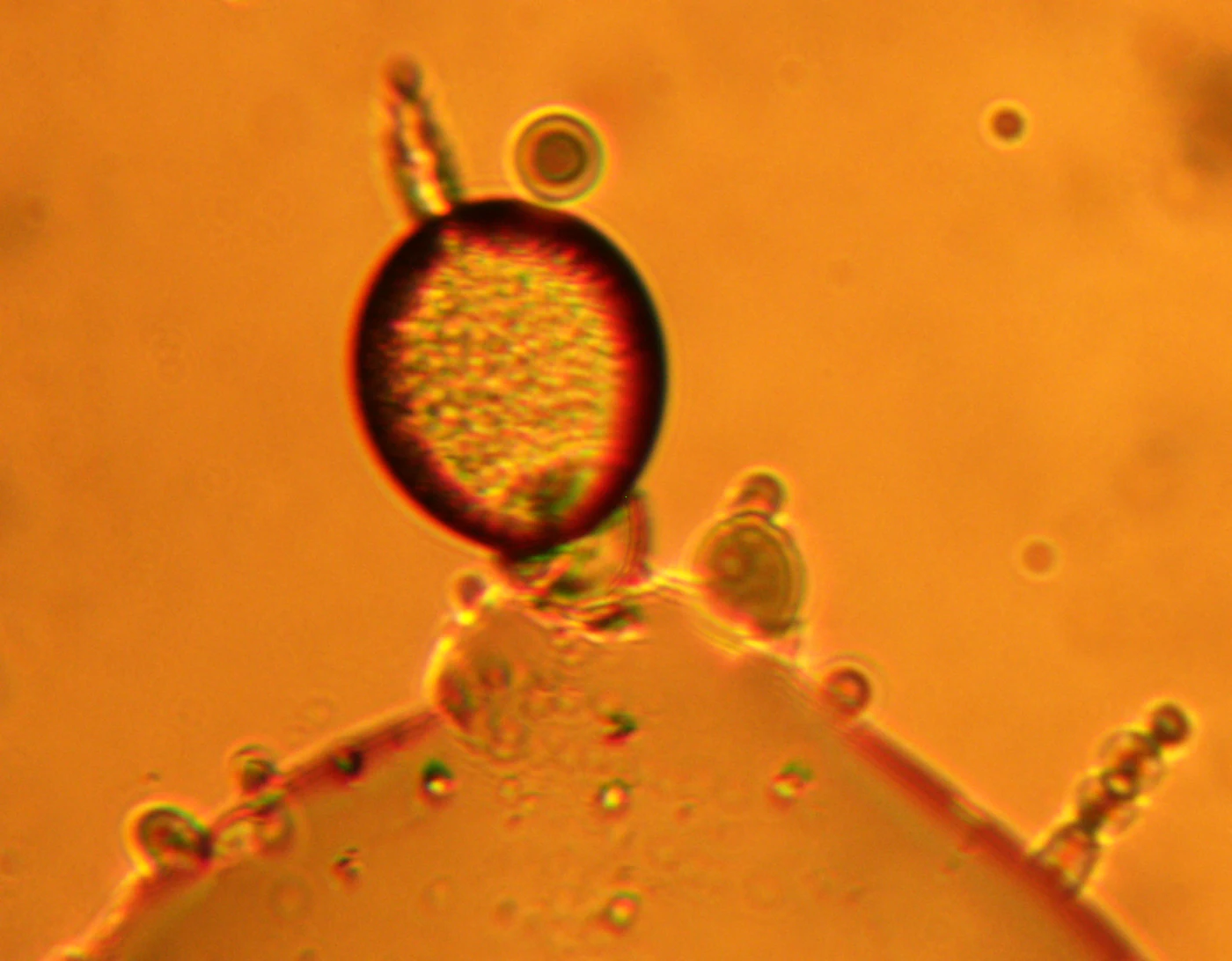
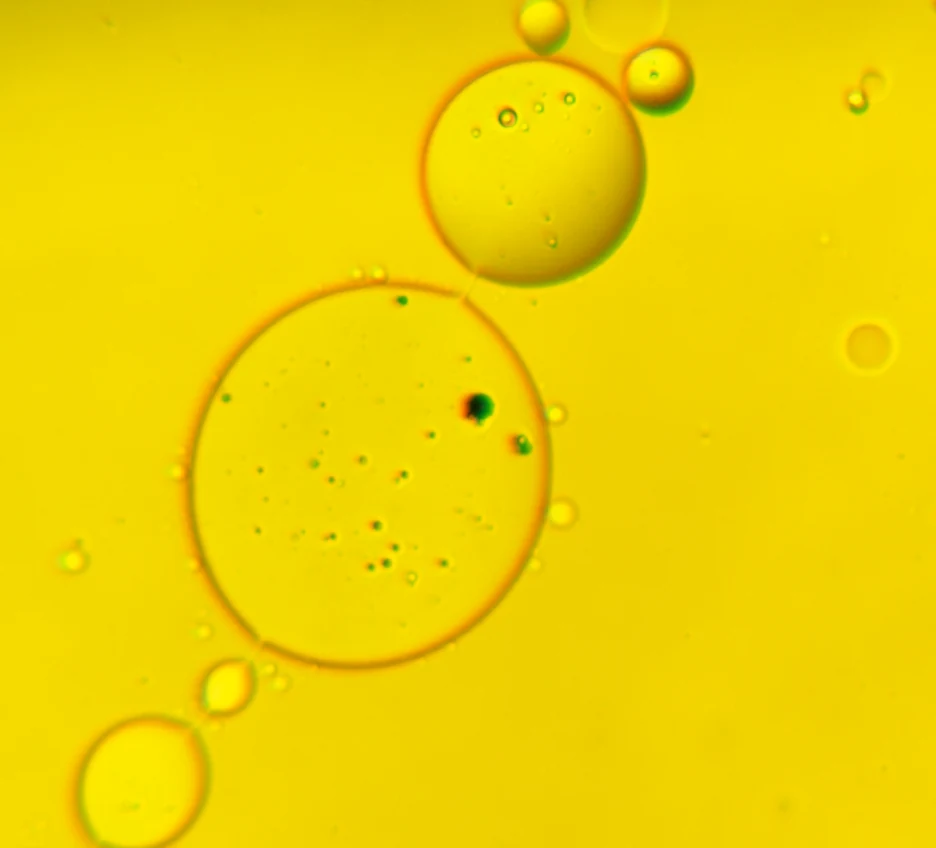
We tried the same with giant unilamellar vesicles (GUVs) in corn oil. The particles inside formed chains and moved toward the vesicle poles, and the vesicles themselves lined up into chains. Particles then passed from one vesicle to the next along the chain. Under the same field, vesicles deformed far less than drops of similar size, and inside them the particle chains attached to the vesicle walls.
The results point to a way to concentrate and remove particles from drops without touching them, as long as the drop is below the critical radius.