ProjectsContact angle rig
Contact angle on heated and cooled surfaces
How does a water drop sit on a surface that is colder or hotter than the room? I built a thermoelectric stage that holds a substrate anywhere from about 12 to 74 °C, and imaged drops on aluminum, glass and Teflon in silhouette across 20 test cases.
- Substrates
- Al 6061 plate (0.8 mm), glass cover slide (1 mm), PTFE plate (0.8 mm)
- Temperature
- Substrate 12.1 to 73.8 °C, set by TEC voltage
- Humidity
- 19% to 55% RH, measured next to the substrate
- Methods
- Shadowgraphy, thermoelectric control, thermocouple DAQ in LabVIEW
Why it matters
The contact angle sets how far a drop spreads and how much surface it wets. That matters wherever drops meet surfaces that are hotter or colder than the air around them: spray and droplet cooling of electronics, condensation on heat-exchanger tubes, and icing. Most contact angle data are taken at room temperature. This rig lets the surface temperature be set independently.
The rig
A thermoelectric (TEC) module sits on a fan-cooled heat sink, with a copper plate on top as a heat spreader and thermal paste between each layer. The substrate rests on the copper. The TEC can cool or heat the copper, and its voltage sets how far the surface moves from room temperature. A surface-mounted thermocouple, logged in LabVIEW, reads the substrate temperature, and a humidity sensor records the relative humidity right next to it.
A needle dispenses a water drop onto the substrate, and a camera records its silhouette against a light source behind it. Each case was recorded as a series of up to eleven frames.
A drop landing
On aluminum at 24.2 °C and 28% relative humidity, a drop grows on the needle until it detaches and lands. Over the next four and a half minutes it slowly evaporates and loses height.
Three surfaces, three temperatures
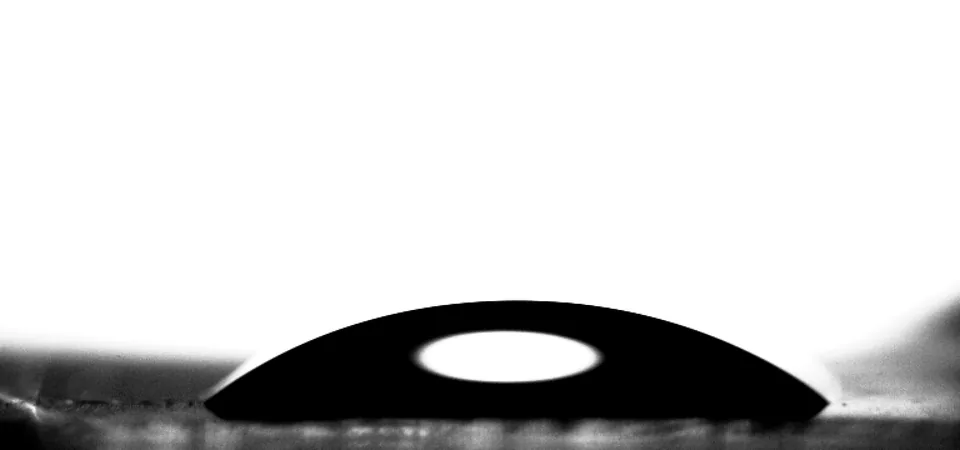
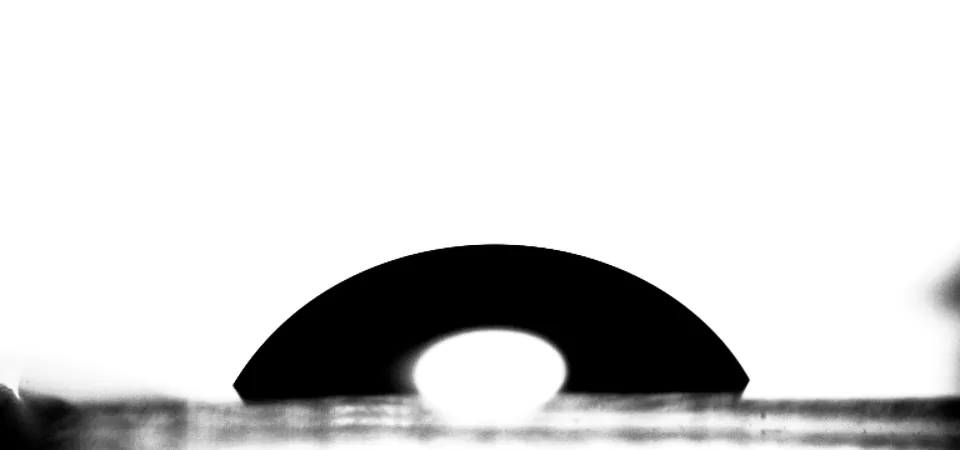
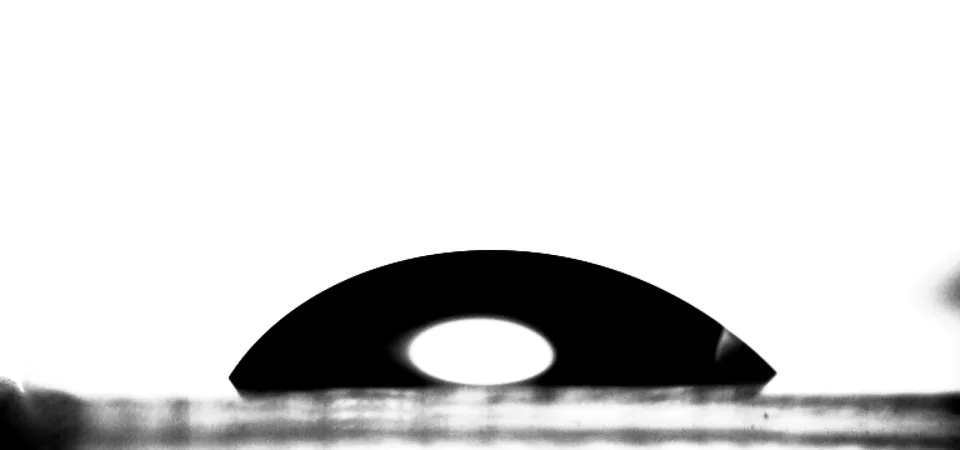
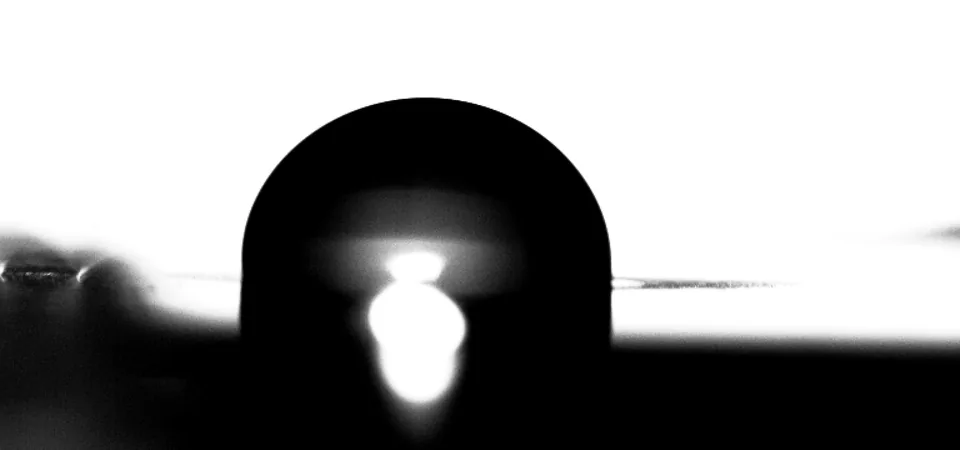
The same drop looks very different on each surface. On PTFE it beads up well past 90° at all three temperatures shown. On aluminum and glass it is far more sensitive, and on the coldest plates the drop spreads much flatter than at room temperature.
Al 6061



Glass
PTFE


Test matrix
Twenty cases across the three substrates. Each lists the plate and substrate temperatures, the relative humidity next to the substrate, and the TEC voltage, as recorded.
| Substrate | Substrate T (°C) | Plate T (°C) | RH near substrate | TEC voltage |
|---|---|---|---|---|
| Al 6061 | 13.6 | 15.1 | 20% | 10.68 V |
| Al 6061 | 18.4 | 19.1 | 41% | 2.18 V |
| Al 6061 | 22.6 | 22.6 | 43% | 0 V |
| Al 6061 | 22.8 | 22.8 | 29% | 0 V |
| Al 6061 | 23.5 | 23.5 | 34% | 0 V |
| Al 6061 | 28.6 | 28.3 | 37% | 0.85 V |
| Al 6061 | 33.5 | 33.0 | 35% | 1.85 V |
| Al 6061 | 68.8 | 66.5 | 22% | 6.03 V |
| Glass | 12.1 | 14.3 | 26% | 3.88 V |
| Glass | 14.0 | 14.9 | 19% | 10.03 V |
| Glass | 17.8 | 19.7 | 25% | 2.4 V |
| Glass | 22.8 | 22.8 | 26% | 0 V |
| Glass | 26.8 | 26.8 | 27% | 0 V |
| Glass | 27.6 | 26.9 | 25% | 1 V |
| Glass | 32.8 | 31.4 | 25% | 1.98 V |
| Glass | 73.8 | 71.4 | 23% | 7 V |
| PTFE (Teflon) | 17.9 | 18.6 | 53% | 1.88 V |
| PTFE (Teflon) | 23.1 | 23.1 | 55% | 0 V |
| PTFE (Teflon) | 28.1 | 27.1 | 53% | 1.05 V |
| PTFE (Teflon) | 33.4 | 32.5 | 52% | 1.88 V |